
How Many Drinks to Reach 0.08% BAC or .15% in Oklahoma
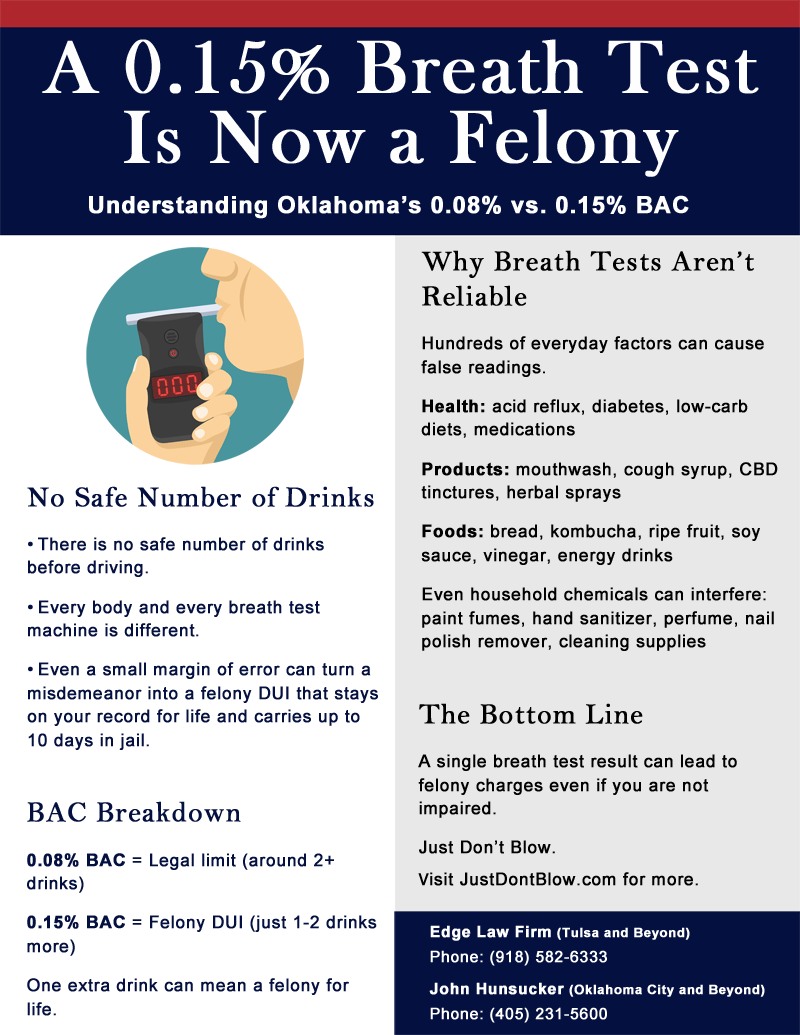
Everyone wants to know the perfect number of drinks that will make them legal to drive in Oklahoma. That number is zero. There is no absolute safe number of drinks that will keep you under 0.08% or 0.15% BAC, because every human body is different and every breath test machine is too. There are hundreds of factors that can affect the results, and none of them are scientifically precise. The truth is, if you drive with alcohol on your breath and get stopped, you are likely going to jail. A single breath test result can be the difference between a misdemeanor and a felony-level DUI charge. The Edge Law Firm continues to educate the public to Just Don’t Blow.
How Many Drinks Is 0.08% Compared to 0.15%?
The legal limit for intoxication sits at 0.08%, a number most people recognize but rarely think about in real terms. It does not take much to get there. For many adults, that is only two or three drinks over the course of an evening. But the distance between 0.08% and 0.15% is where everything changes. That small stretch on the scale can turn a routine traffic stop into a felony-level DUI with serious consequences that reach far beyond a fine or license suspension. The difference might only be a couple of drinks, yet legally, it is the difference between a mistake and a serious criminal charge.
 Take Ed, who weighs about 175 pounds, and Cindy, who weighs about 135 pounds, both close to national averages. For Ed, two to three standard drinks in an hour, such as beers or glasses of wine, can push his blood alcohol level to around 0.08%, right at the legal limit. A couple more drinks and he could hit 0.15%, crossing into aggravated or felony DUI territory. Cindy’s numbers climb faster. Two drinks can place her near 0.08%, and by four or five drinks she may be over 0.15%. A few extra drinks, sometimes over a single dinner, can quietly shift a night out from social to serious. What feels like control can quickly become a criminal charge.
Why Breath Tests Are Not Always Reliable
What is most important to understand about breath tests is that they are not always accurate. There are hundreds of variables that can cause false or inflated results, including acid reflux, diabetes, low-carb diets, certain medications, and other health conditions. Breath-testing devices detect alcohol-like compounds, but they cannot always tell the difference between actual alcohol and similar substances your body naturally produces.
Even common over-the-counter medications and personal care products can lead to false positives. Cold and cough syrups, mouthwash, throat sprays, allergy medicines, sleep aids, and even herbal or CBD tinctures often contain trace amounts of alcohol or chemicals that interfere with breath sensors.
Certain foods and drinks can also trigger false readings because they contain trace alcohol or ingredients that mimic it. Examples include white bread, yeast-based doughs, soy sauce, ripe fruit, kombucha, vinegar, vanilla extract, protein bars, and energy drinks. Eating or drinking these shortly before testing can cause a temporary but significant spike in BAC results.
Everyday Chemicals Can Also Affect Breath Tests
Breathalyzers can sometimes give false readings because they react to everyday products and fumes, not just alcohol. Common chemicals found in paint, glue, cleaning supplies, gasoline fumes, and exhaust can give off vapors that confuse the machine. Even hand sanitizers, disinfectant sprays, nail polish remover, perfume, and hair products can cause issues after frequent use. People who work around construction materials, fuel, or industrial cleaners breathe in substances that can linger in their system and mimic alcohol, sometimes enough to elevate a reading close to 0.15% BAC even without drinking.
The Bottom Line
As a new law is in effect, our position remains simple: do not give the opposing side evidence they can use against you. A single breath result can carry felony-level consequences, even when your true level of impairment may not reflect those numbers. Breath test machines are not accurate, so do not trust them. To learn more, please visit: JustDontBlow.com
Please submit our secure contact form below: