
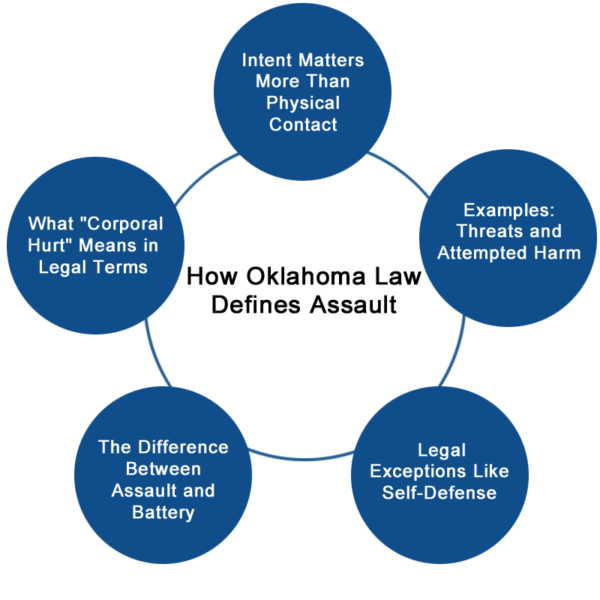
Oklahoma law defines assault as an act of force or violence that is willfully and illegally perpetrated on another to cause bodily harm. Because the language focuses on the intention more than the result, assault can be committed even if physical contact does not occur.
One example would be a person swinging a punch at another person, who dodges it in time. The act itself, intended to cause injury as it was, would qualify as assault even though contact did not occur. Another example would be a person verbally threatening violence toward another person then picking up an object as if to throw it at them. The words don’t necessarily constitute assault on their own, but combined with the show of force, they could be construed that way.
There are exceptions for actions that have a legal excuse, such as a person striking someone else in self-defense. But apart from that, if the action is intended to cause physical harm – referred to as “corporal hurt” in legal terms – or is otherwise threatening, Oklahoma law can consider it assault.
When physical injury does occur, that is considered battery. Going back to our first example of the punch that was dodged, if that punch had actually landed it could be construed as battery since unlawful physical force was used. The essential difference between the two is that assault is an attempt to cause bodily harm while battery is the actual use of physical force.
Misdemeanor Assault vs. Felony Assault
The circumstances surrounding the incident can have a large impact on whether assault charges are treated as a felony or a misdemeanor by the state. An example of a misdemeanor assault would be one person shoving another during an argument. As simple battery, it can be punished by as much as a year in county jail. If the shoving match escalates and one party brandishes a knife, that can be considered a felony and could potentially lead to life in prison. An assault can also lead to stricter punishments if the victim is a family member of the attacker. As an act legally considered to be domestic violence, it carries much higher penalties than simple assault. Similarly, acts of violence against protected people such as judges, teachers or law enforcement officers can carry much higher consequences.
Simple Assault vs. Aggravated Assault
Oklahoma law recognizes two different degrees of assault: simple assault and aggravated assault. The difference between them stems from the seriousness of the threat or the circumstances surrounding the initial incident. In cases of simple assault, a minor threat was issued or an attempt was made to cause harm without physical contact occurring. In cases of aggravated assault, the danger is amplified by factors such as the presence of a deadly weapon, intent to cause serious bodily harm, or targeting a victim who is particularly vulnerable. As a more serious offense, aggravated assault typically carries higher consequences and penalties.
Simple Assault vs. Simple Assault and Battery
The laws regarding assault in Oklahoma law also include two separate charges for simple assault and simple assault and battery. Ultimately, the difference between the two charges is whether or not physical contact occurred. As mentioned earlier, simple assault does not necessarily require that contact, but can occur when threats or attempts are made to physically harm. Because it creates a fear of harm, it is considered simple assault. When actual physical contact occurs, from a heavy shove to an actual strike with a fist, the perpetrator can be charged with simple assault and battery.
Understanding Assault Charges
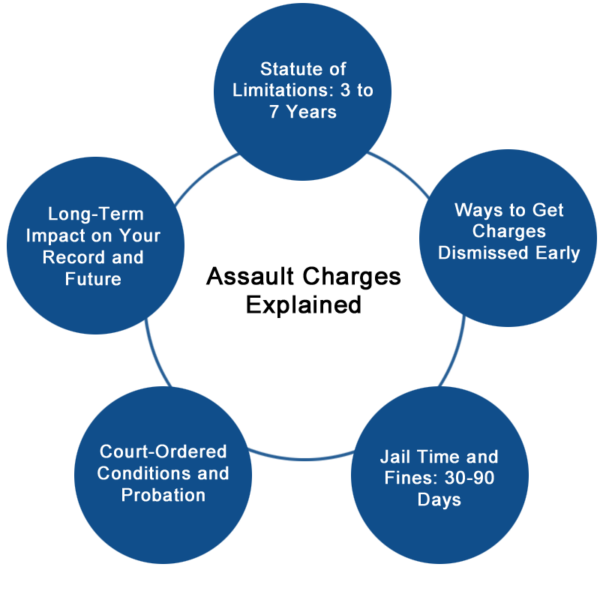
Under Oklahoma law, an assault charge generally carries a statute of limitations of three years, meaning that the prosecution has three years from the initial incident to formally file charges. In certain severe cases, such as felony-level assault, that statute of limitation can be extended to seven years. Otherwise, once that deadline has passed, prosecution can no longer file charges.
Once charges have been formally introduced by the prosecution, it is still possible to have those charges dismissed in court if a defense attorney is able to present a sufficiently convincing argument early in the process. Among issues they might highlight are insufficient evidence on the part of the prosecution, procedural errors that were made during the arrest, constitutional violations that occurred, or lack of witnesses. They may also put forward evidence that contradicts or disproves the case against their client. In certain cases, an attorney can plea for entrance in diversion programs or counseling, negotiating for a dismissal.
While not as serious as a felony charge, even a misdemeanor charge of simple assault can carry massive repercussions upon conviction. The judge has quite a bit of discretion in determining the appropriate punishment, ranging from financial penalties to court-ordered conditions, but the general penalties include up to 30 days in county jail and/or $500 in fines. Assault and battery charges, in which physical contact occurs, can carry even higher penalties including up to 90 days in jail and/or fines up to $1,000.
And those are just the baseline of what a judge can order. Additional consequences can include:
- Supervised or unsupervised probation with mandatory check-ins and adherence to court-ordered rules.
- Drug or alcohol monitoring and restrictions.
- Compulsory community service.
- Mandatory anger management courses or counseling sessions.
- Issuance of protective or no-contact order for the alleged victim’s protection.
- Payment of court costs as well as restitution to the alleged victim including medical expenses, property damage or lost wages.
- Long-term consequences including a mark on the defendant’s permanent criminal record, loss of employment or licensure and damage to their standing in the community.
Defending Against Assault Charges
In Oklahoma, as in many states, an accusation of simple assault is not the same as a conviction. There are many ways that a skilled defense attorney can defend against claims of simple assault using the facts and circumstances of your particular case. Several that have proven effective include:
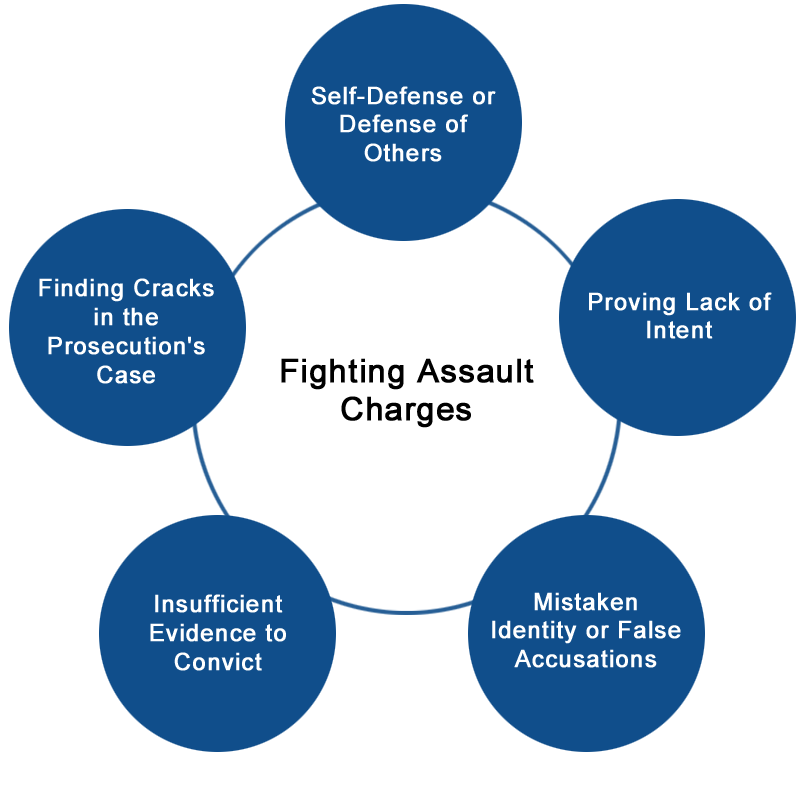
- Claiming Self-Defense or Defense of Others: If you perceived an immediate threat to yourself or those around you, you have the legal right to defend yourself in a way that’s commensurate with the danger. An example would be someone raising a fist to strike you or a person next to you, and you shoving them away. A claim of self-defense also covers actions taken to prevent property damage or theft.
- Demonstrating Lack of Intent: The legal definition of assault requires intent – that the actions taken were meant to incite fear or threaten. If the incident was accidental, for example you bump into someone in a crowded bar, then that lack of intent could lead to charges being dismissed.
- Claiming Mistaken Identity or False Accusations: In the chaos of the moment, it can be easy for someone to mistakenly assign responsibility to an innocent bystander. An example of this would be somebody blaming an individual for a fight at a busy concert who was just a bystander, as long as that bystander can produce witnesses to say they weren’t involved.
- Showing Lack of Evidence: The onus falls on the prosecution to prove guilt beyond a reasonable doubt. This strategy involves showing that the prosecution lacks the evidence to prove that, citing a dearth of witnesses, security camera footage or other proof.
These strategies, coordinated by a skilled legal team, can help you see charges reduced, dismissed or acquitted. At The Edge Law Firm, we’ve used all these strategies and more to win cases for our clients. Our methods involve scrutinizing every detail of the case and analyzing every piece of evidence to find the cracks in the prosecution’s case. Armed with that knowledge, we’ve seen clients cleared of charges, even when the state was attempting to settle for reduced charges.
The Edge Law Firm Difference
No attorney has ever won a case by making empty promises to their clients or relying on luck. Winning is a matter of dogged preparation, exhaustive research and thorough examination of every fact. That’s the approach we take, beginning with your very first consultation. No matter the circumstances, we plan for the worst, prepping for every case as if it’s going to trial. That means launching our own investigation into the facts, analyzing every detail no matter how small, and challenging every aspect of the case against you.
The prosecution simply can’t match this meticulous methodology, leaving our team far ahead of them in terms of finding the details that can swing a case. And that is how we protect our clients. Don’t let the prosecution convince you that you are out of options. You don’t have to face these charges on your own. Call us today to schedule your free no-obligation evaluation of your case, and put The Edge Law Firm to work for you. In person or over the phone, we’ll cover everything about your case, letting you tell your story and giving you understanding of what comes next. You’ll walk out empowered and ready to fight, knowing you have a winning team by your side. Fill out your contact information below to get started.
A Simple Process to Getting Started

Schedule a Free Case Evaluation
Schedule your free and confidential consultation with The Edge Law Firm in person, online, or over the phone. Click here to schedule your case evaluation.

Meet Our Defense Team
During your free case evaluation, you’ll have the opportunity to ask legal questions, receive professional advice, share your side of the story, and begin gathering evidence. This consultation can help you explore options and defense strategies you may not have considered and give you the peace of mind to rest easier tonight.

Start Defending Your Case
After your free case evaluation, The Edge Law Firm will provide a personalized quote for representation and begin protecting your rights immediately, with the goal of achieving a dismissal, reduction, or acquittal.